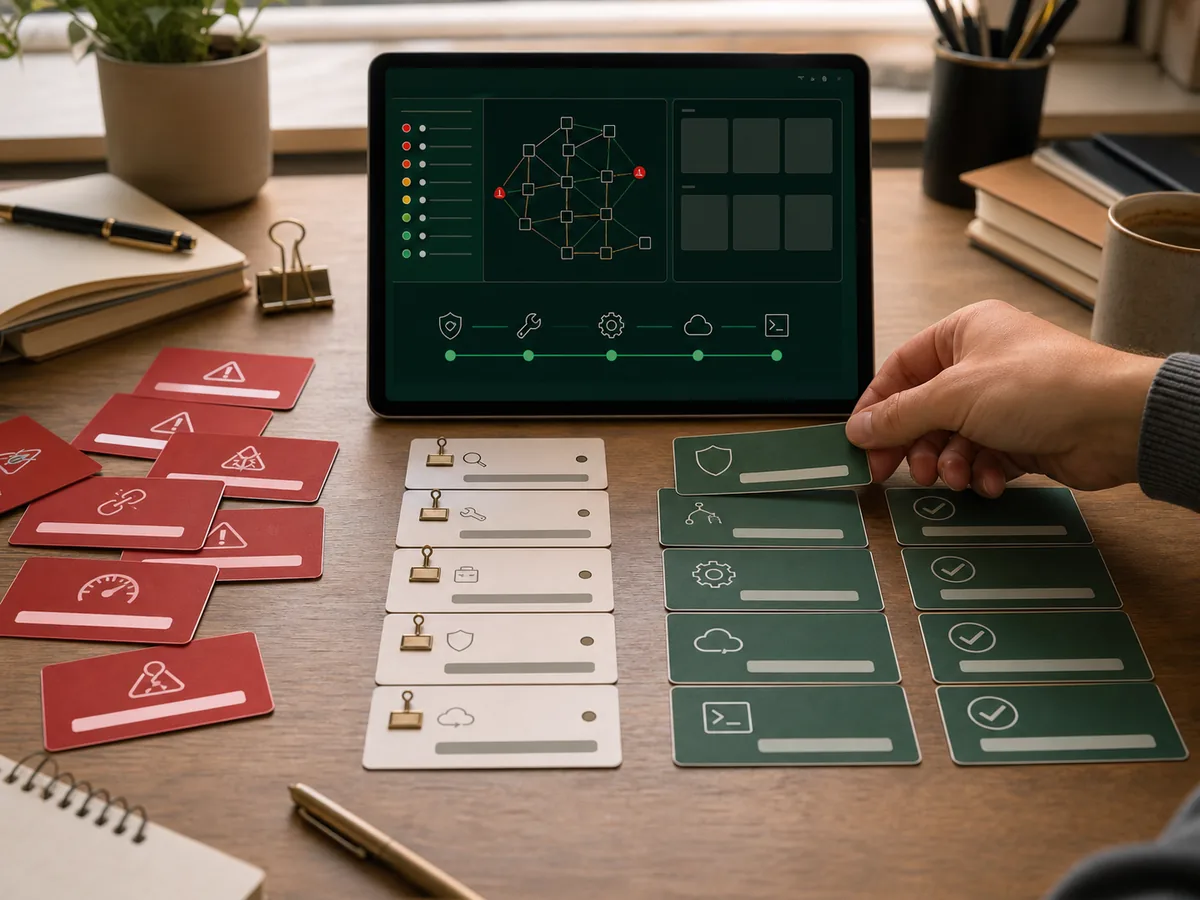
Taking over an abandoned Laravel project is less about reading every line of code and more about reducing uncertainty in the right order. The first goal is not a new feature. It is a repeatable, observable system that can be changed safely.
When this guide applies
Use this sequence when the original team is unavailable, deployment knowledge is incomplete or production behaviour cannot be explained from the repository alone. If account ownership is unresolved, treat that as the first delivery risk.
1. Secure the assets before touching production
Collect the repository, deployment credentials, DNS, database access, object storage, queues, scheduler settings and third-party accounts. Rotate credentials that belonged to people who have left. Create a read-only database backup and verify that it can be restored.
Do not accept screenshots of environment variables as a handover. Record each secret by purpose and owner without committing the value to source control.
2. Reproduce the application
Build the project in an isolated environment from documented steps. Record the PHP version, extensions, Composer version, Node version, queue driver and storage configuration. If the build only works on one old server, that is the first operational risk.
Run migrations against a copy of the database, not production. Compare the migration history with the actual schema; abandoned projects often contain manual database changes that were never recorded.
3. Trace the critical business workflows
Choose the workflows that can lose money, block operations or expose data. Typical examples are login, payment, order creation, stock adjustment and file access. Follow each flow through controllers, jobs, events, database writes and external callbacks.
This is more useful than rating every class. A visually untidy module may be stable; a clean-looking payment callback without idempotency may be dangerous.
4. Establish an evidence baseline
Capture current automated tests, application logs, error rates, slow queries and failed jobs. If these signals do not exist, add the minimum observability needed to diagnose the first recovery milestone.
Create a short risk register with four fields: impact, likelihood, evidence and next action. Separate known defects from assumptions that still need verification.
5. Define a bounded recovery milestone
A good first milestone has one operational outcome and clear acceptance evidence. Examples include making deployment repeatable, stabilising payment callbacks, or restoring reliable inventory movements.
Avoid combining framework upgrades, infrastructure migration and new product features into the same first release. Each change removes the evidence needed to identify the cause of a regression.
6. Estimate only after the review
The review should produce a system map, risk list, recovery backlog and estimate range. Fixed estimates made before reproduction and workflow tracing usually transfer hidden risk to either the client or the development team.
The right takeover process turns an unknown system into a sequence of decisions. Once the system can be built, observed and tested, normal feature planning can resume.
When to pause feature work
Pause feature estimates when the application cannot be reproduced, backups have not been restored in a safe environment, or a high-risk workflow still has no owner or test evidence. These gaps change the scope more than a new screen request does.
Related services
For a structured recovery review before new feature delivery, see Existing Project Rescue & Stabilisation.