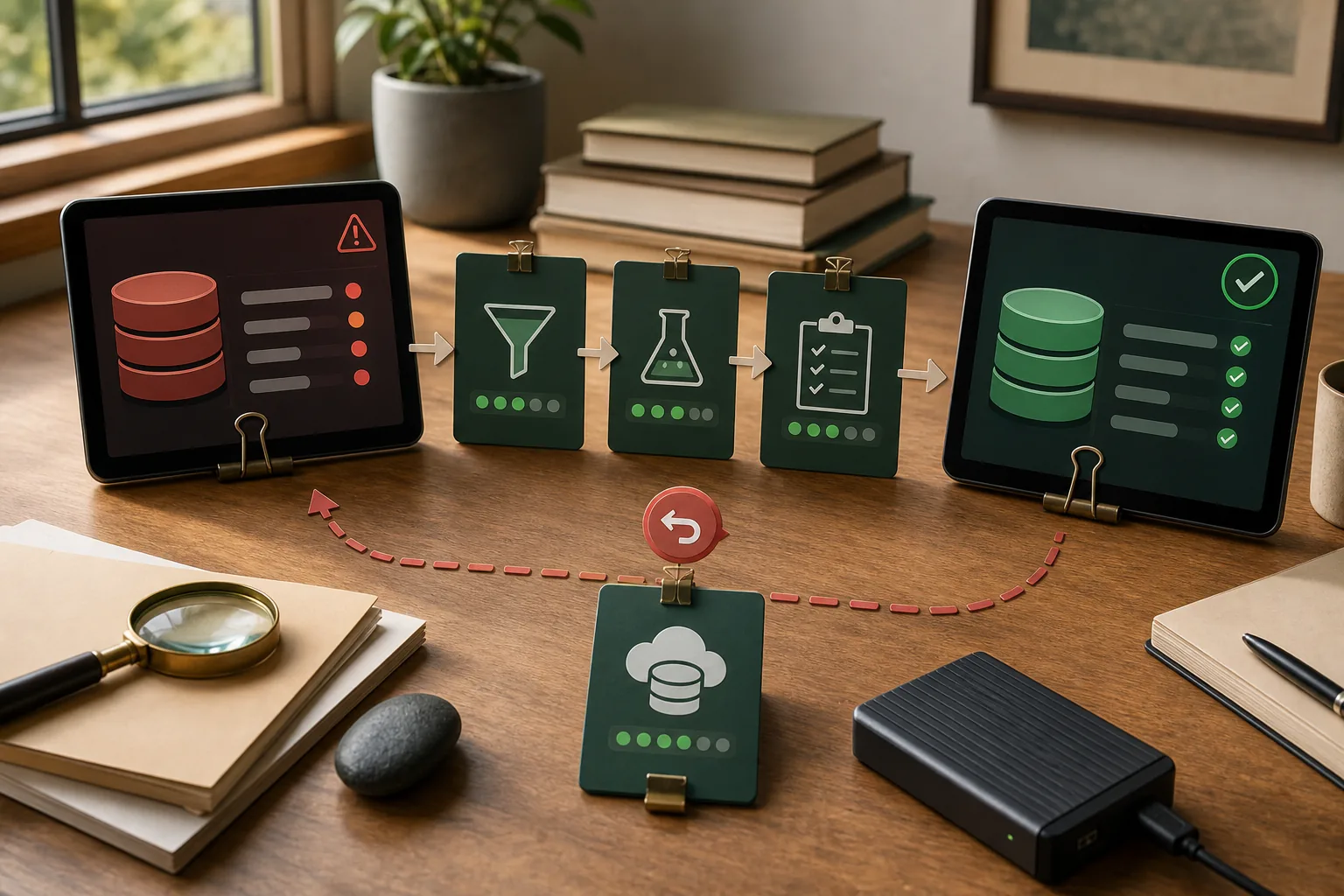
Copied data is not proof that cutover is safe
A team must move business data without discovering after cutover that balances, permissions or historical records no longer reconcile.
The first useful conversation is about the operating fact that could become wrong, rather than a screen, framework, or optimistic delivery date. For data migration validation rollback plan, the review should define source authority, mapping rules, validation totals, cutover window, rollback trigger and the owner who may approve each decision. That gives the people responsible for the system a shared starting point before they make a production change.
Define the part of the workflow that must stay correct
A review of data migration validation rollback plan needs a boundary. Identify the trigger, the record whose state changes, any external dependency, and the point at which staff or customers see the result. The relevant boundary here is to define source authority, mapping rules, validation totals, cutover window, rollback trigger and the owner who may approve each decision. Keeping that boundary small makes it possible to test one change without concealing its effect behind unrelated work.
Write down who can approve a temporary workaround and who can stop the release. For data migration validation rollback plan, those responsibilities should be attached to the records and dependencies described in row counts, control totals, sample records, attachment links, reference data, change freeze rules and a tested restore point. That is what keeps a normal-path failure from becoming an unowned operational problem.
Gather evidence from the running system
Start with row counts, control totals, sample records, attachment links, reference data, change freeze rules and a tested restore point. These are the facts that reveal whether the current behaviour is understood or merely assumed. Capture their source, the time checked, and the person who can explain an inconsistency.
For data migration validation rollback plan, an evidence set is useful only when it can answer practical questions: which system owns the current state, what proves success, what cannot be replayed safely, and where an exception should wait for review. A long checklist without those answers adds noise rather than confidence.
Work through one representative case
Follow one real record from the initiating action through validation, storage, asynchronous processing, external calls, and the final visible result. The question raised by this topic is: A team must move business data without discovering after cutover that balances, permissions or historical records no longer reconcile. A technically successful response can still leave the operational result incomplete or wrong.
Make the first change reversible. Depending on the system, that can mean retaining an old contract, using an additive schema change, preserving a restore point, or pausing a non-critical automation. The recovery path should support the decision to define source authority, mapping rules, validation totals, cutover window, rollback trigger and the owner who may approve each decision, not exist only as a note in a deployment ticket.
Define how an operator sees a stalled or disputed record. For data migration validation rollback plan, attach row counts, control totals, sample records, attachment links, reference data, change freeze rules and a tested restore point to the exception, name the role allowed to act, and state the escalation condition. This makes exception handling part of the workflow instead of an improvised response after customers have already been affected.
The first acceptance check should be concrete: compare records, inspect the audit trail, perform a safe recovery exercise, and confirm that the accountable owner can explain the result. The next step is to run rehearsal migrations and use the same acceptance queries that will be used during the final cutover.
Decide what the first milestone has to prove
A first milestone for data migration validation rollback plan should not be a broad promise to “fix the system”. It should prove that the team can define source authority, mapping rules, validation totals, cutover window, rollback trigger and the owner who may approve each decision with the current records and dependencies in view. That proof may be a repeatable deployment, a reconciled transaction, an observable queue, a verified migration rehearsal, or a documented permission test.
Keep the milestone small enough to fail safely. If the evidence from row counts, control totals, sample records, attachment links, reference data, change freeze rules and a tested restore point changes the scope, say so before expanding work. A useful milestone produces a decision: continue with the next workflow, correct an assumption, or pause because the risk is larger than the original request suggested.
Questions that need an owner
Before the change starts, name the owner for the source record, the recovery decision, and the exception queue. Ask what happens if the dependency is slow, unavailable, or returns a result that conflicts with local data. Those questions are specific to data migration validation rollback plan; they cannot be answered by a generic delivery checklist.
Also agree how the team will distinguish a temporary workaround from a lasting fix. The answer should connect the observed result to run rehearsal migrations and use the same acceptance queries that will be used during the final cutover. When an assumption has no owner, it tends to become an incident assigned to whoever happens to be available.
Keep the decision visible after release
The work does not end when the change reaches production. Review the first operating cycle with the people who handle the records, not only the people who wrote the code. Compare the outcome with the condition described at the start: A team must move business data without discovering after cutover that balances, permissions or historical records no longer reconcile. If the result differs, retain the evidence rather than making an untracked manual correction.
A concise record of the review is enough. Note the date, the sample checked, the remaining exception, and whether the next action is still run rehearsal migrations and use the same acceptance queries that will be used during the final cutover. This habit is particularly useful when data migration validation rollback plan later becomes part of a larger project, because it stops the team from rediscovering the same uncertainty during every handover.
Keep the scope honest
It is reasonable to defer work that does not affect the current business outcome. It is not reasonable to hide that deferral inside a broad estimate. State which dependencies remain outside the scope, what evidence has not been collected, and when the decision to revisit them will be made. For data migration validation rollback plan, this keeps the first release useful without pretending that it resolves every related system concern or creates a false sense of completion for the operating team after one release cycle concludes. Review it with the operator.
Assumptions worth challenging before release
The costly shortcut in this area is easy to recognise: A migration that finishes copying is not complete until business totals and exception records are independently checked. It usually feels efficient until the team needs to reconstruct what happened from incomplete records.
Challenge assumptions about ownership, retries, data correction, and rollback in writing. For data migration validation rollback plan, a useful implementation note states what is out of scope, which missing fact would change the estimate, and which action must never run twice. That is a more reliable basis for delivery than a broad assurance that edge cases will be handled later.
Close the loop with an operating check
For data migration validation rollback plan, use one or two measures that relate to this workflow: unreconciled records, age of pending work, time to resolve an exception, or a release check that can be observed by the team. The measure should show whether the situation described above is improving, not decorate a dashboard.
A short closure note should record the evidence reviewed, remaining exceptions, the date of the decision, and the next review point before the team moves on to run rehearsal migrations and use the same acceptance queries that will be used during the final cutover. For structured support, see backend development. The related inventory system rescue is an illustrative planning scenario, not a claimed client outcome. If this matches your situation, discuss the project.