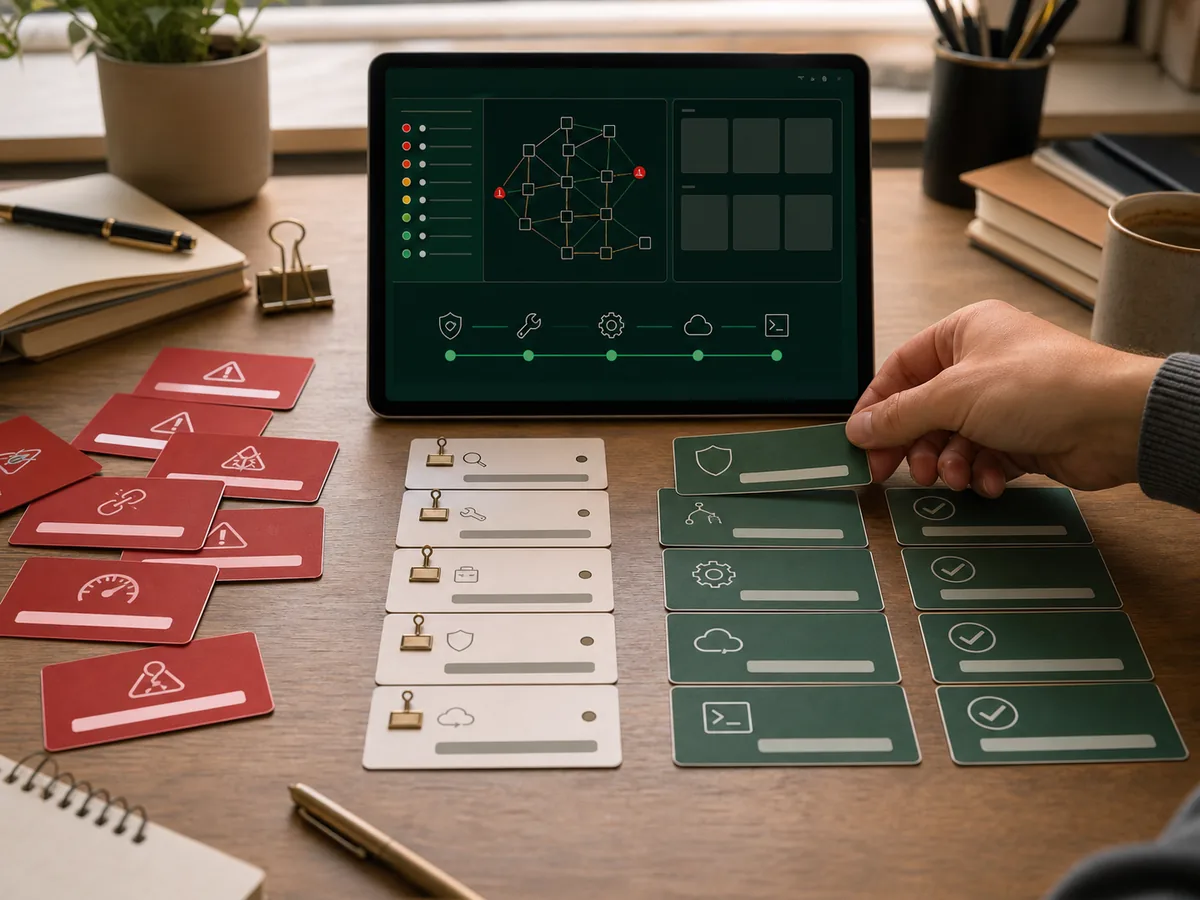
Where legacy software security patch plan becomes an operating risk
A reported vulnerability creates pressure to act quickly, while the old application may have no reliable test suite or deployment history. That is why legacy software security patch plan needs a decision boundary before anyone estimates a feature or changes a configuration. Start by naming one record, one actor and one outcome that would be expensive to get wrong. A useful review stays close to the day-to-day work: a person submits something, another person acts on it, and the system must leave enough evidence for both of them to trust the result.
In Legacy Software Security Patch Plan: Fix Urgent Risks Without Breaking Production, teams often begin with screens and integrations because they are easy to point at. The harder question is what the organisation must still be able to prove after a delay, a retry or a disagreement. The work starts with evidence from the running system, not a promise to modernise everything at once. Write that answer down in ordinary language before turning it into a ticket.
Set a boundary before drawing a solution
For legacy software security patch plan, map the trigger, the current record, the decision that changes it, the external dependency and the visible result. Do not pretend that every surrounding problem belongs in the first release. A narrow boundary makes it possible to test a change and to explain what was deliberately left for later.
Ask who owns the source of truth, who may approve an exception and who has authority to stop the change. Those names matter more than a polished process diagram. When an exception occurs on a busy afternoon, an unowned decision becomes a queue that nobody touches. That distinction matters here because a reported vulnerability creates pressure to act quickly, while the old application may have no reliable test suite or deployment history.
Collect evidence that somebody can check later
Use a short evidence pack rather than a long requirements document. For this topic, the pack should include:
affected component — record where it comes from, when it was checked and the person who can explain a mismatch.
exposed route — record where it comes from, when it was checked and the person who can explain a mismatch.
dependency version — record where it comes from, when it was checked and the person who can explain a mismatch.
backup point — record where it comes from, when it was checked and the person who can explain a mismatch.
rollback owner — record where it comes from, when it was checked and the person who can explain a mismatch.
For legacy software security patch plan, evidence is useful when it changes a decision. A screenshot without a record reference, for example, may show that a screen existed but cannot prove which customer, order or account was affected. Keep identifiers, dates and the rule that was applied together.
Walk through one real example
Choose a recent, ordinary case rather than the cleanest demo. Follow it from the first input through validation, storage, background work, external calls and the final message seen by staff or customers. Pause at every hand-off. What should happen if the next system is slow? What should happen if the same action arrives twice? What evidence would show that a manual correction is safe? That distinction matters here because a reported vulnerability creates pressure to act quickly, while the old application may have no reliable test suite or deployment history.
The legacy software security patch plan walkthrough exposes assumptions that a feature list hides. It also gives the team a small acceptance sample. If the proposed design cannot handle this sample with a clear recovery path, increasing the scope will only make the uncertainty more expensive.
Make decisions explicit
A practical legacy software security patch plan plan records the decision, the reason, the owner and the date on which it should be reviewed. It should distinguish a rule that is enforced by the system from a workaround that relies on someone remembering what to do. Those are different kinds of risk.
For Legacy Software Security Patch Plan: Fix Urgent Risks Without Breaking Production, keep the first milestone modest. It might prove that a mapping is reversible, that an operator can complete a representative case, that a retry cannot create a duplicate business effect, or that a release can be rolled back without losing evidence. The milestone earns confidence by being observable, not by sounding ambitious.
Watch for the shortcuts that create later incidents
In legacy software security patch plan, one common mistake is to use a successful request or deployment as proof of a completed business outcome. Another is to let a single person hold the missing knowledge because it seems faster than documenting the boundary. A third is to combine unrelated clean-up work with the change under review, then lose the ability to explain a regression.
The safer legacy software security patch plan approach is less dramatic: preserve the current state, test a representative case, keep an exception queue and decide in advance who can approve a correction. It takes discipline, but it is easier than reconstructing a disputed record after the fact.
Verify the result with the operating team
Before closing Legacy Software Security Patch Plan: Fix Urgent Risks Without Breaking Production, compare the result with the original question. Check the record, the audit trail, the related system and the person who handles the workflow. If something remains unresolved, describe it plainly and give it an owner. A hidden exception does not become harmless because the release date has passed.
For related engineering support, see existing project rescue and backend development. The illustrative planning scenario shows the kind of operational boundary that should be made visible before a larger change. If you are assessing a live system, discuss the project. That distinction matters here because a reported vulnerability creates pressure to act quickly, while the old application may have no reliable test suite or deployment history.
A useful legacy software security patch plan review can fit on a few pages when it names the decisions that matter. Length does not make a plan safer. Traceable facts, a recovery boundary and an owner for the awkward cases do.
Treat the first operating cycle as part of the legacy software security patch plan delivery. Ask the people who use it where they had to pause, look elsewhere or invent a workaround. Their answer usually points to the next improvement faster than a broad retrospective.
Keep the legacy software security patch plan decision log close to the work. A dated note that links a business record, a test result and a named owner is more valuable than a polished summary that cannot be checked when circumstances change.
When new evidence changes the scope of legacy software security patch plan, say so early. A changed estimate is easier to manage than a team quietly carrying an assumption until it becomes an incident.
The test for a durable legacy software security patch plan process is simple: a colleague who was absent from the original discussion should be able to follow the record, recognise an exception and know whom to ask before making a correction.
Before the next change, revisit the original legacy software security patch plan sample with the latest data and people involved. A process can look sound when it is designed, then drift as permissions, suppliers and operating habits change. This small check keeps the team close to what is actually happening.